
Adolescence in War and Peace – Its Seeds and Its Fruit
Adolescence in War and Peace – Its Seeds and Its Fruit
Reflections on my Journey from Women for Women International Supporter to Staff
All women remember their teen years – some with joy, others with pain, and most with a hormonal tangle of both. It is a tender, if not graceless, time; bodies in strange flux, hearts beating with new pulses, minds unmarred by disillusion.
When I think of my own adolescence, if I scroll back from the fever dream that is sixteen and fifteen and fourteen – budding love crushed by roaring heartbreak, hardened into protective cynicism – and land on that hopeful, fresh-faced moment that is being twelve years old, one of the first things I think of is Women for Women International.
My first encounter with the organisation was an interception, a childish reach for something that wasn’t hers. It came in the form of a fundraising solicitation letter – the kind that in my current role I might have easily written myself – addressed to my parents. I disregarded their name as my eyes drifted to the logo, which compelled me for a reason I couldn’t articulate, and ripped it open madly as though it contained a gift. In a way, it did.

I’ll skim past the details of my discovery – the point is that it catapulted me into a new world, one of courageous and determined women standing firm amidst raging injustice and harrowing loss, in faraway places pocked with violence and brutality. What these women had was more than resilience. It was grace, and all I knew was that I wanted to have something to do with it.
I collected my savings, a combination of birthday money and babysitting earnings, and bartered the cash for my mother’s credit card. At the time, the organisation offered a sponsorship programme – now known as Stand With Her – whereby supporters could be matched with a woman in its year-long Stronger Women, Stronger Nations training programme. I signed up and was matched with a woman named Chantal from the Democratic Republic of Congo.
Chantal. I liked her name. It had a ring to it, delicate like the clinking of a spoon against a champagne glass. It sounded like 'chandelier', made me think of crystals and diamonds, like the ones that adorned the shimmering structure above my parents’ dining room table. I wouldn’t have had the language or perspective at twelve to understand these glittering associations as inappropriate or privileged, though I wasn’t entirely off the mark either.
Later I would learn about blood diamonds, wide-eyed as I read about the vast, sparkling mineral reserves embedded deep within mines throughout Chantal’s country – ‘blood’ because of the widespread bloodshed caused by illicit trade and exploitation by international corporations acting through rebel groups. I would learn how the struggle for control over mineral-rich areas had caused the death and displacement of millions and left the entire region destabilised, and I would also learn how global demand for these minerals – used in everyday electronics like smartphones and laptops – ensured that the illegal trade continues (you can learn more about conflict and our work in the DRC here.)

Some months later, I received a letter from Chantal in the post. The Women for Women International logo winked at me in the corner of the envelope. The fact that it was addressed to me filled me with pride.
In the letter, she addressed me as her ‘friend’ and began to list the facts of her life. She was twenty-eight and married, and she and her husband were both cultivators. Together they had seven children, the oldest sixteen. Then: Thank you for all that you are doing for me. May God bless you during your whole life. I’d like to get your picture. I don’t have much to say. Yours, Chantal.
It is hard for me to describe the experience of receiving that letter. It touched something in me that is too visceral to capture with words. Let’s just say that I was “deeply moved” and leave it at that.
As I read and re-read her letter, it dawned on me that she was my age – twelve – when she became a mother. Trying to make sense of that fact was like being told that I was not, in fact, a twiggy schoolgirl, but a muscled, fearsome warrior. I surveyed my own life for anything that might be suggestive of motherhood, came up empty. At the time, our radical difference in circumstance made it seem like we were on different planets. It took some growing up to appreciate that we are more similar than different, and that that is what makes our connection one of solidarity, rather than charity.
Chantal had included a photo with her letter. I had never seen a face like that before. Her features were elegant but worn, weary. Now, I might call it life-battered; at the time, all I knew was that she looked much older than her years. The years accumulate differently in places where suffering is dense.

I took it all in, then busied myself with writing a response. I got out my blood mineral smartphone and took a selfie, because that’s what pre-teens did at the time (and perhaps still do), got it printed and enclosed it along with a heartfelt letter about how much she had inspired me, how I wished we could meet and I could understand more about her world. I’ll never know how she felt about my letter, but I imagine she was far too consumed with childrearing and farm labour to be particularly moved by my well-intended fangirling.
After that, I was flying. I sponsored another woman, and another, and another. I devoured memoirs written by survivors of sexual violence and conflict, binged documentaries on the same subject. And though from fourteen to eighteen the intensity of these discoveries dimmed behind the more pressing concerns of high school romance and rebellion, they did not disappear.
The seeds had been planted, and when it was time for university they burst through the soil. I remembered Chantal and her twelve-year-old motherhood, her beautiful face worn down with the violence of blood diamonds and the greed of men. I decided to study global health and development.
Then, I was 22, looking for a job. Ten years after the discovery that set me on the path, I wound my way back to the Women for Women International website. They had rebranded. The new logo – sleek, more polished – didn’t wink at me like the previous one had. Perhaps it didn’t recognise me. But as I moved through the site and saw once again the faces of the powerful women that had initiated my adolescent self into a world much bigger than my own, a familiar warmth returned. I knew this was where I belonged.
There was a vacancy in the Marketing and Communications team, and I applied. In the four years since, I have accompanied the organisation as it rebranded its classic sponsorship model in an effort to decolonise language away from outdated notions of ‘rescuing’ and towards a more equal stance of solidarity. I have written solicitation letters like the one I intercepted from my parents over a decade ago. I have encountered countless stories like Chantal’s from all over the world and worked with dedicated colleagues to weave them into compelling cases for support, moving people from sympathy to action (you can sign up to stand with a woman survivor of war like Chantal here.) And though I have come to learn about suffering and bravery from many parts of the world, the DRC will always have my heart.

But let me return to where this began.
Even as adolescence may be a universal rite of passage, the nature of that passage varies greatly along those unforgiving lines called luck. My adolescence meant freedom and abandon, education and curiosity; Chantal’s meant motherhood and poverty, work and weariness.
It didn’t have to.
When Women for Women International launched its Adolescent Girls Programme, my heart smiled. For a moment, I was no longer sitting at the office behind a laptop screen; I was once again a child bursting with the magnificent realisation that there was something I could do to make things better. That perhaps it was less an option than an imperative.
Adolescence is not just a punishment, though it can often feel that way. It’s a golden opportunity – and when girls in conflict-affected countries are supported at this critical juncture, they can not only thrive, but they can become powerful agents of change in their communities.
Chantal’s daughters have grown up now, and I like to imagine that because of the knowledge, skills and support their mother gained from the programme, they entered into adulthood on stronger footing. I like to imagine that they are out there carving very bright futures, even as violence in the DRC continues – futures that involve education, equality and empowerment.
Perhaps it is self-aggrandising to imagine that 12-year-old me made a difference that rippled into the next generation. It is easy to feel as though we have no real power as individuals, especially as the cynicism of adulthood gradually dims that hopeful, helpful quality inherent in youth, and the planet rattles with crisis after crisis. It is certainly easier to think that and do nothing than to make the effort to do what you can, however small. All I know is that after four years of working in communications at Women for Women International, the phrase “ripple effect of change” is embedded inside my skull like a tattoo, and I have heard enough stories from the countries where we work to believe it to be true.
I know now that many of the women who join our programme do go on to become powerful changemakers. I know now that the mothers among them do pass their knowledge onto their children, so that they can build their lives on a stronger foundation. And I know now that it means everything to these women to know that someone across the world – though separated by geography and circumstance – cares about them enough to invest in their future.
I go forward with well-evidenced certainty that if every person were to claim the small power they do have, this blue world – in its beauty, madness and bewildering complexity – can be transformed into a place that allows everyone to realise their potential. For that emboldening belief, I have one woman to thank.
After changing the course of my life, Chantal ended her letter with I don’t have much to say. I will always be humbled by that radiant humility; I will always remember that grace.


STAND WITH HER
Help us provide critical support to women affected by conflict.
Your generous donation will help women living in some of the world's most dangerous places empower themselves with the social and economic skills they need to transform their lives.
Read more
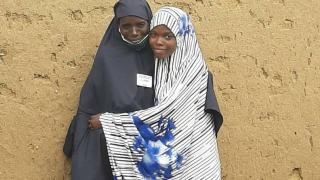
Every woman has the power to transform her own life — and the lives of girls around her. On International Day of the Girl Child, we are spotlighting the barriers to equality facing girls in Nigeria and the women working to clear the way.
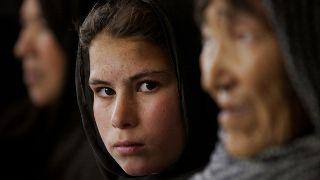
Since the Taliban’s return to power in Afghanistan in August 2021, Afghan women have experienced profound changes in their daily lives. The de facto government has reinstated many restrictions, severely limiting the rights and freedoms of women and girls.
Yet, in the face of these challenges, Afghan women have shown extraordinary determination and strength, finding ways to resist and adapt. Here, we explore five significant ways their lives have changed, highlighting both the difficulties they face and their ongoing fight for their rights.
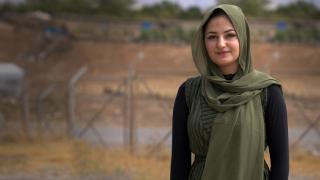
Amina
subtitle:
In Afghanistan, Amina* dares to stand up for women’s rights. Women have been virtually erased from public life over the past two years: banned from parks, gyms, restaurants, most jobs and education. Opposing these restrictions is incredibly dangerous, but Amina dares to keep teaching in our training centre. She braves the constant scrutiny of government authorities and she dares to spread the word that education should be the right of every woman and girl.
*Although the story is real, for reasons of security and privacy, we're not using Amina's real name or photograph.