
Iqbal's Story
My name is Iqbal
My name is Iqbal Elias Al-Touni.
I was born in Baghdad in 1977. I’m a mother of seven, five daughters and two sons. I married young and didn’t finish school, but I kept learning in other ways.
In 2006, on July 20, we left Baghdad for Qaraqosh because of sectarian violence. Starting over was hard, but I couldn’t afford to wait for things to improve on their own. I opened a small women’s clothing shop. After about a year, I added a second idea: renting dresses for weddings and special occasions. Little by little, the work began to hold us up. With what I earned, and with a housing loan, we built a home. For a while, it felt like we had reached something close to stability.
That didn’t last. In 2014, when ISIS entered the area, the home burned. The shop burned. Years of effort disappeared in a few hours. We were displaced again, this time to Erbil, where we lived for three years. We didn’t only lose income. We lived with constant uncertainty, and the fear of not knowing what would happen next.
When the area was liberated, we went back to Al Hamdaniya. We returned with no project, no savings and no clear way to rebuild a life. My husband’s retirement salary was modest and barely covered the needs of seven children.
Some organisations supported us in repairing the house. I also began moving between trainings and community programmes, learning handicrafts. At first, it was simply about finding a way to earn something. But it was also about staying on my feet, about not letting what happened in 2014 define the rest of my life.
After we returned, the damage wasn’t only physical. I could see fear on people’s faces and I saw how quickly mistrust grew between different groups: ethnicity, religion, sect. People blamed one another and women often carried the consequences first, inside their homes and in the wider community. That hurt me deeply. I didn’t want to add to the tension and I didn’t want to live in it either.
I wanted to be someone who could help calm things down, even in small ways.
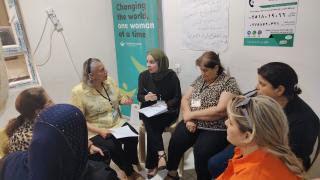
I joined a local women’s organisation focused on women’s empowerment. Through meetings and dialogue sessions, we tried to reduce misunderstandings and bring people closer to each other. We listened, we discussed community conflicts and we supported women when they faced problems at home or in public life. Over time, I stopped seeing this work as extra. It felt necessary.
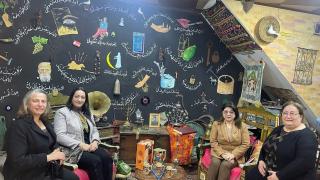
As the work grew, so did my role. I became involved in advocacy with other women. We started communicating with local decision makers and offices: water services, the municipality, the real estate registration office and community police. We raised people’s complaints, followed up on unresolved issues and pushed for practical solutions. Sometimes support looked like guidance. Sometimes it meant helping someone connect to services. Sometimes it meant small financial help when there was no other option.
I gave this work most of my time because I believed the community needed it, and because no one should be left to face these problems alone.
Later, I joined Women for Women International through the Stronger Women Stronger Nations programme. The sessions helped me understand different forms of violence and conflict, and what peacebuilding can look like in daily life, not as a slogan, but as real choices and responsibilities.
I learned more about women’s rights and the legal protections meant to support them, and I gained practical skills in community engagement, advocacy and awareness raising. I also learned basics in livelihoods development, planning and managing small projects.
Just as important, the programme helped me rebuild my confidence. After losing everything in 2014, I carried fear for a long time, fear of failing again, fear of starting something new and watching it disappear.
With steady support and encouragement, I began to trust myself again.
I started a small home based handicrafts business, which helped bring some income into our household. It wasn’t only about money. It was about feeling capable again.
Today, when I look back, I don’t only see displacement and loss. I see the steps I took to keep my family standing, and the way my life shifted from trying to survive to trying to contribute. I believe peace starts in the way we treat each other at home, and in the way we speak to each other in the community. It grows when people listen instead of accusing.
I don’t need a title to know what I’ve done. I just try to do what I can, in the place where I live, with the people around me.
WHEN THE WORLD’S ATTENTION MOVES ON, WILL YOU STAND WITH HER?
Support a woman survivor of war through our year-long Stronger Women, Stronger Nations programme. Your solidarity will help her use her voice, realise her power and rebuild her life.
Read more stories
Ikilima
subtitle:
"My friend told me about the programme and said that I would be helped to repair the strained relationship in my family, and I would be taught how to negotiate with him so that we could have discussions as husband and wife."
Faizah
subtitle:
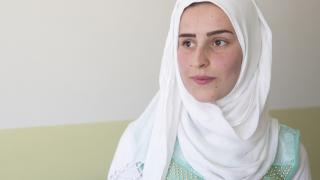
Faizah has always been brave – even aged 13, when her uncles tried to force her into marriage. So, when ISIS attacked her community and warned her not to flee, she harnessed that defiance and dared to find safety. Faizah dreams of a world without war; of peace for her children. Here is her story.

Yasmin
subtitle:
Falsely imprisoned and left with trauma that stayed long after her release, Yasmin refused to let her past define her. With the support of Women for Women International’s Stronger Women, Stronger Nations programme in Palestine, she is learning new skills, rebuilding her confidence and daring to dream of a brighter future.